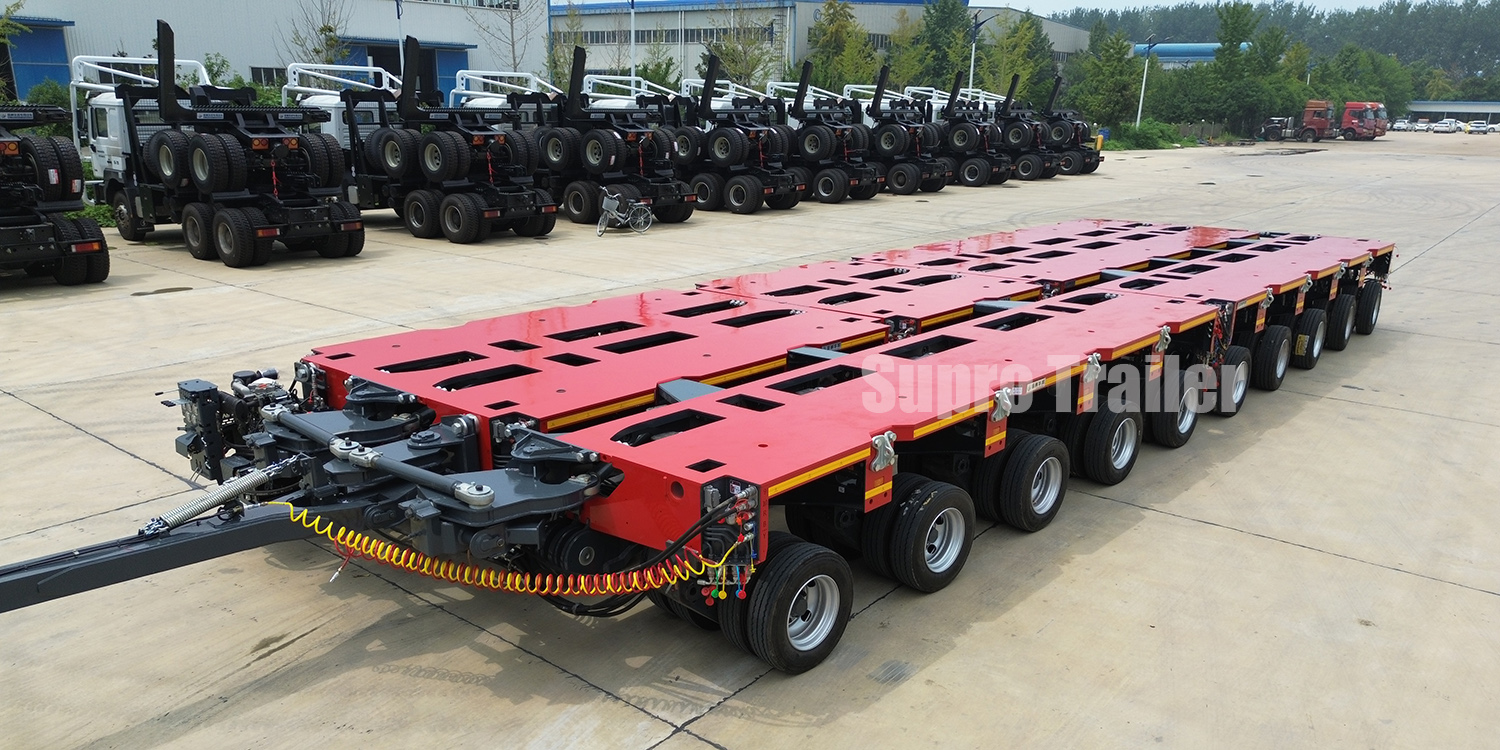
550 Ton Girder Bridge Completes a 600 Ton Static Load Test
❐ Over eight days at Supro Trailer's factory in China, a team from Israel's Taavura took part in the assembly, inspection and testing of a 550-ton Girder Bridge. The work covered component connections, structural questions, a 600-ton static load test, measurements after unloading and a final inspection after disassembly.
The Taavura team joins the assembly work
❐ Taavura CEO Gadi went straight into the assembly workshop when he arrived at the factory. He was joined by engineer Aviram, Israeli fleet manager Ivan and site supervisor Harder. All four inspected the bridge details, discussed them with our team and took part in the assembly work.
❐ Assembly began by setting the distance between the two side beams. The team measured both diagonals and checked that they were equal to confirm alignment and symmetry. They then installed the transverse tie rods one by one and connected the other side beam to the load equalizing beam. All four mechanical pins passed smoothly through their matching connection holes, completing the first stage.
Checking alignment and the assembly method
❐ Before fitting the main girders, Aviram measured their camber and recorded the initial readings as a baseline for later checks. Ivan and Harder handled the main assembly operations, helping them become familiar with the installation process through practical work.
❐ The teams discussed two methods for connecting the main girders and side beams. Aviram preferred to fully straighten the side beams before making the connection. Our workshop supervisor proposed adjusting their position during connection by moving the tractor unit. After discussing both methods, the team followed the supervisor's approach. The connection was completed, and all eight hydraulic pins were fitted successfully.
Resolving technical questions before loading
❐ During assembly, the Taavura team raised a question about the strength of the transverse tie rods. Extending the threaded section reduced the overlap between the inner and outer sleeves. The customer wanted to understand whether this would affect the strength of the assembly. We explained the design, how the tie rods carried the forces and the role of the sleeve overlap. Work continued with the load support beams and slings after the team had discussed and understood these points.
❐ A check before loading also identified a small position difference between the front and rear ends of the main girders. Aviram suggested removing all the tie rods and realigning the beams. Our supervisor proposed loosening only some of the tie rods and using the others as adjustment points. After several small corrections, the main girders and side beams were correctly aligned. This avoided removing every tie rod and allowed test preparations to continue.
Applying a 600 ton static test load
❐ The Girder Bridge has a rated load capacity of 550 tons. For this factory static test, the applied load was 600 tons. This was a test load, not an operating transport load.
The load was arranged in two layers: 200 tons of high-strength steel plates at the bottom and 400 tons of reinforced concrete test blocks above. Once the full load was in place, Aviram measured and recorded the bridge's key points. The bridge then remained under the 600-ton load overnight.
❐ The next morning, Aviram measured the same points again and compared them with the previous day's records. Unloading began only after all measurements had been taken and recorded. The Taavura team worked alongside our factory staff as the load was gradually removed.
Measuring recovery after unloading
❐ The static test also included checking how the structure recovered after unloading. Once all test loads had been removed and the bridge had time to recover, Aviram measured each key point again and compared the results with the original readings taken before loading.
❐ All recorded measurements after unloading matched the readings taken before loading, completing the static test. The work then moved on to driving and hydraulic lifting checks.
A final inspection after disassembly
❐ On the final day of their visit, the Taavura team returned to the workshop and stayed while the bridge was dismantled. They inspected every hydraulic connection pin and connection plate for any abnormalities following assembly, the 600-ton static test and the subsequent checks. The team left the factory only after completing the inspection and confirming that these components were in normal condition.
❐ These eight days gave the customer a direct view of how the equipment was assembled, how technical questions were resolved and how the test results were checked. For Supro Trailer, working through each inspection with the customer and answering their questions clearly is an important part of building confidence in heavy transport equipment.
Day 1:This CEO Didn`t Come Just to Watch▼
Day 2 | The Engineer and Crew Supervisor Have Different Ideas▼
Day 3 | Are the Cross Tie Rods Still Strong Enough When Extended?▼
Day 4 | Ready to Load 600 Tons, but Work Had Stopped▼
Day 5 | Why Load a 550-Ton Girder Bridge with 600 Tons?▼
Day 6 | A Night Under 600 Tons: What Did the Measurements Show?▼
Day 7 | The Rebound Data After Unloading Is the Final Test▼
Day 8 | Before Leaving the Factory, They Checking It One More Time▼
Let`s hear what the Israeli engineer, Mr.Aviram had to say after the girder bridge commissioning!▼